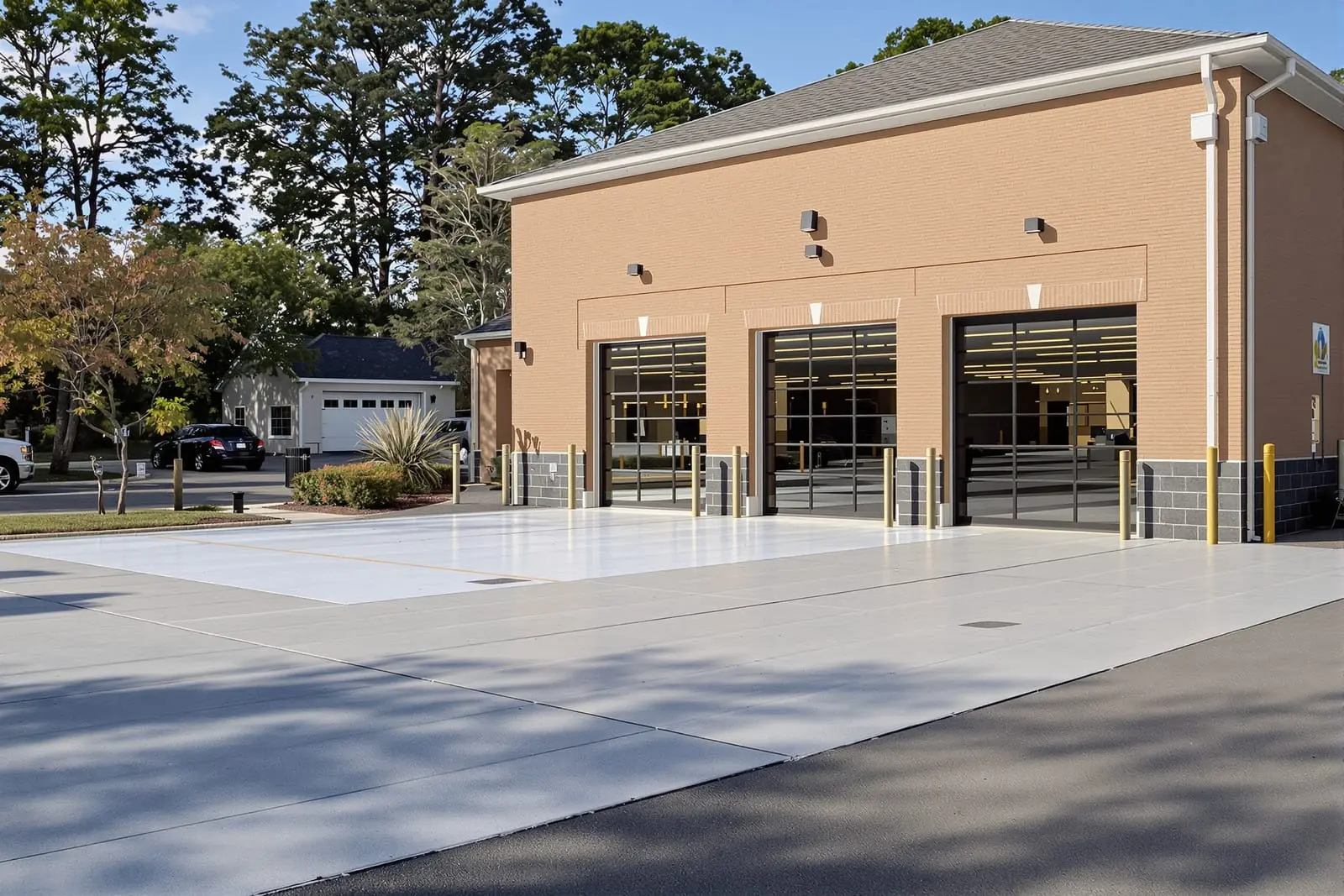
Handle heavy use with a properly built commercial concrete slab in Franklin, TN. We pour reinforced slabs for loading docks, dumpster pads, and equipment bases. Correct thickness, reinforcement, and joint layout keep slabs stable under repeated loading. Protect your facility operations with rugged concrete work areas.
Primetime Concrete Franklin provides professional commercial concrete slab throughout Franklin, TN and the surrounding area. Our licensed, insured crew delivers safe, clean, on-time work with a free estimate before anything begins. Call (615) 716-0343 or request your free quote.
Commercial slab and loading dock work in Franklin, TN
Primetime Concrete Franklin builds commercial concrete slab systems and loading docks that match how businesses in Franklin actually operate. We work on distribution centers along I-65, light industrial buildings near Cool Springs, retrofits in older commercial strips, and back-of-house loading areas on tight downtown lots.
For every project, we start with use and load planning, not just square footage. We look at what will be on the slab (racking, pallet jacks, forklifts, dock levelers, trailer weights) and how often each area is used. A warehouse that sees weekly box truck deliveries needs a very different slab and dock configuration than a manufacturing space with constant 18-wheeler traffic.
We also pay close attention to Franklin soils. Much of the area has clay that shrinks and swells, plus fill dirt around newer commercial developments. That movement is what causes many slab cracks and dock settlement issues. Our crews adjust base prep, thickness, and reinforcement based on what we find when we excavate, not a one-size-fits-all spec.
How we build a durable commercial concrete slab
A commercial concrete slab is more than concrete poured on dirt. Primetime Concrete Franklin follows a specific sequence so the floor stays flat, strong, and usable for the long term.
1) Layout and cut. We confirm building lines, slab elevations, and door thresholds. For interior slabs in existing buildings, we sawcut and remove old concrete in controlled sections to protect structure and utilities.
2) Subgrade and base prep. We excavate to design depth, then compact the native soil. In Franklin, if we hit soft clay, organics, or uncontrolled fill, we remove it and bring in compactable stone. We typically place and compact 4 to 8 inches of crushed stone base, more where heavy rack loads or trailer traffic are expected.
3) Vapor barrier and insulation. For conditioned spaces or areas storing sensitive goods, we add a vapor barrier under the slab so ground moisture does not telegraph up. Where energy codes or use require it, we coordinate rigid insulation under or at slab edges.
4) Reinforcement and thickened sections. For a true commercial concrete slab, we use a combination of rebar, welded wire mesh, and sometimes fiber reinforcement. Around heavy column lines, equipment pads, and dock areas, we thicken the slab and tighten rebar spacing. This is where many “budget” slabs get cut, which later shows up as settlement and cracking.
5) Pouring, finishing, and joints. We place the concrete in controlled sections, use mechanical screeds or laser-guided equipment when flatness is critical, and finish the surface based on use (broom, hard trowel, or trowel with a sealer). We cut contraction joints at calculated spacings to control where cracks form, then seal joints where needed to prevent edge damage under forklift traffic.
What goes into a reliable loading dock
Loading docks fail early when the transition from building slab to pavement is not designed and built correctly. Primetime Concrete Franklin treats docks like a structural component, not just a ramp.
We start by reviewing your trucks and dock equipment. Dock height has to match your typical trailers, not just an industry average. We coordinate concrete elevations with dock levelers, bumpers, seals, and overhead doors, and we confirm you have safe approach angles based on your lot layout.
For the structural slab at the dock face, we typically thicken the concrete, use heavier rebar, and extend the reinforced slab out under the dock leveler and impact zone. We design the slab to handle concentrated wheel loads where trailers hit the bumpers and where forklifts cross the dock edge dozens or hundreds of times per day.
The area in front of the dock, often called the apron, is where a lot of damage shows up in Franklin. We see broken pavement right at the joint between the building slab and the asphalt drive. To avoid this, we often recommend a reinforced concrete apron at least several feet out from the building, with doweled connections and proper joint layout. This costs more upfront than just paving in asphalt but saves repeated patching and trip hazards.
Drainage is another key item. We set dock slabs and aprons so water runs away from doors, then integrate trench drains or inlets where needed. In winter, poorly drained docks collect ice right at the work area. We grade to prevent that from the start.
Common slab and dock problems in Franklin and how we address them
Because we work across Franklin and Williamson County, we see consistent patterns in commercial slab and loading dock failures. Knowing these helps us design out the same issues in new work and fix them correctly in repairs.
Settlement at dock faces. Older commercial buildings along Murfreesboro Road and in older industrial pockets often have sinking concrete at the dock edge. This usually comes from poorly compacted fill or washout along the building line. We address this by removing weak material, recompacting, installing a thicker reinforced slab section, and tying it back into the building slab with dowels so the joint acts together.
Random cracking and spalling. Many warehouse slabs were placed with inadequate joints or light reinforcement. Heavy rack legs or point loads then cause cracks and surface pop-outs. For repair, we may cut and replace isolated panels, add dowels at new joints, and, where appropriate, grind and fill cracks to restore a smooth forklift path.
Poor slopes and drainage. Some loading areas were built flat to match door elevations, so water ponds and eventually enters the building. When we correct this, we reprofile concrete and surrounding pavement so water moves to drains or away from the building, and we adjust thresholds or dock equipment as needed.
Surface wear and dusting. Interior slabs that see forklift traffic but were never hardened can polish and get slick or dusty. We address this by applying densifiers, sealers, or installing a thin bonded overlay if the existing slab has enough structural capacity to justify saving.
What affects cost for commercial concrete slabs and loading docks
Primetime Concrete Franklin prices commercial slabs and docks based on what it takes to perform the work correctly for your specific use and site, not just a simple price per square foot.
Key cost drivers for a commercial concrete slab include required thickness, reinforcement type and spacing, concrete mix strength, vapor barrier and insulation needs, and finish type. A light storage space in a Franklin office-warehouse condo might use a 4 to 5 inch slab with standard reinforcing, while a high-bay distribution center with continuous forklift use and tall rack legs may require a thicker slab with more steel and tighter joint spacing.
For loading docks, costs change based on the number of doors, need for dock levelers or lift plates, concrete apron size, and how much ground correction is needed. Rebuilding an older dock in a tight urban lot often takes more labor and sawcutting than a new shell building in a greenfield site.
Subgrade conditions are another major factor. If we find unsuitable soils, buried debris, or poor fill when we excavate, the base preparation will require more stone and compaction effort. Spending properly on the foundation of the slab significantly reduces future repair bills.
We also look at access and phasing. If work is inside an active facility, we may need to pour in smaller sections, work off-hours, or coordinate with your operations schedule. That planning protects your business from downtime and is part of the true project cost, even if it does not show up on a material list.
What local businesses should know before hiring a concrete contractor
When you hire someone to build a commercial concrete slab or loading dock in Franklin, you want a contractor who understands both structural requirements and day-to-day use. Primetime Concrete Franklin encourages property managers, GC’s, and owners to ask specific questions before choosing a contractor.
Request design details, not just a quote. A trustworthy contractor will talk through slab thickness, reinforcement layout, joint spacing, and base prep. If a proposal only mentions “4-inch slab, wire mesh” with no context about loads or use, you are likely not getting a system designed for long-term commercial work.
Ask how they handle Franklin soil conditions. You want to hear about compaction testing, stone base depth ranges, and what they do if they encounter soft spots. A rigid schedule that does not allow any adjustment for site conditions is a warning sign.
Discuss how your facility will stay operational. For retrofits, we plan work so you can keep at least part of your dock line or floor in service. That might mean night or weekend pours, or dividing the job into phases with clear curing and traffic timelines.
Finally, request references for similar projects. We can point you to distribution and light industrial jobs in and around Franklin so you can see how the slabs and docks are holding up under real use, not just how they looked the day they were poured.
“
Professional loading docks & commercial slabs, done right the first time, quality materials, honest pricing, and results that last.
Primetime Concrete Franklin
Loading Docks & Commercial Slabs Across Our Service Area