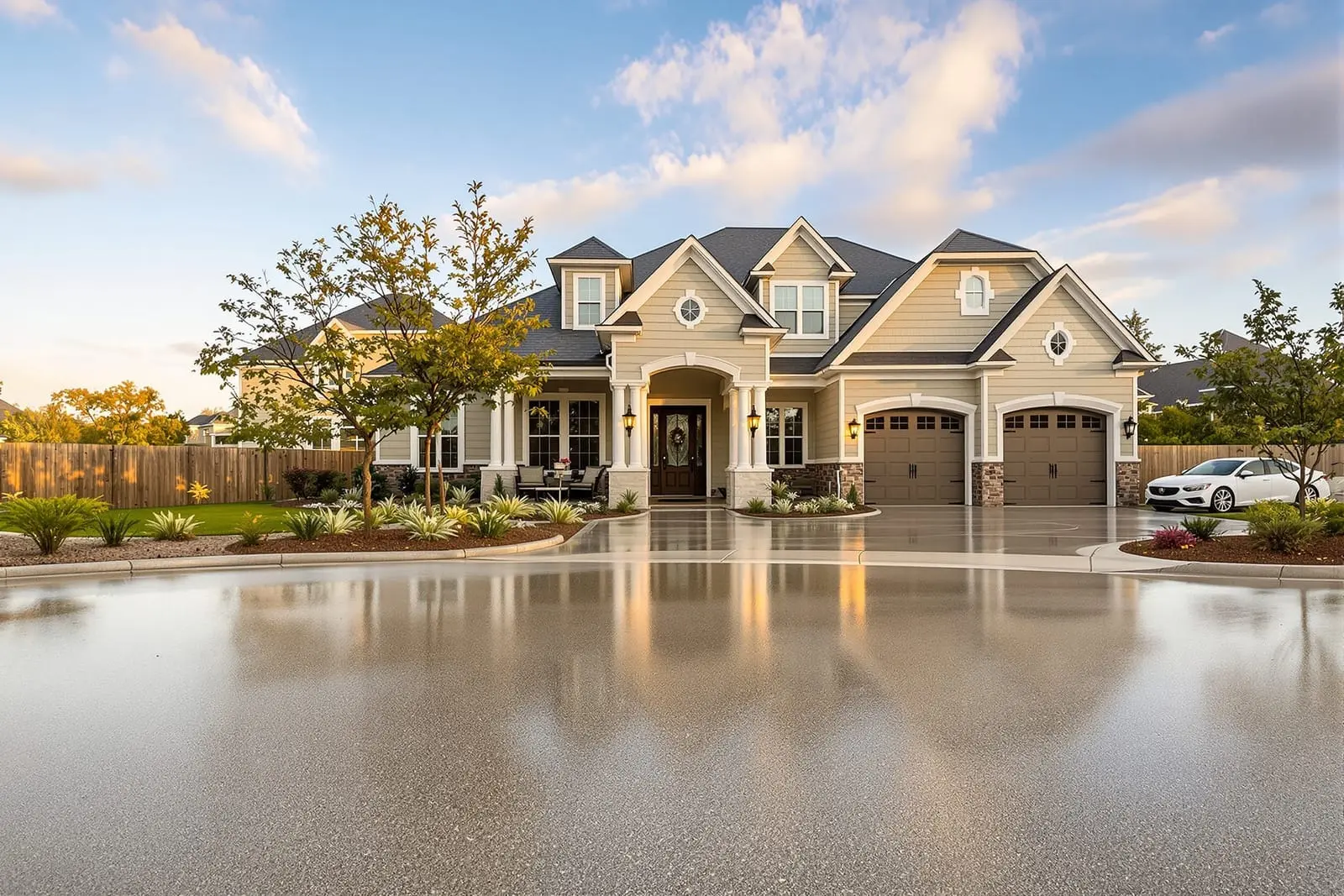
Support public infrastructure with municipal and site concrete in Franklin, TN. We construct sidewalks, ramps, plazas, and curbs for cities, schools, and developments. Our crews are experienced with specs, inspections, and staging work safely around the public.
Primetime Concrete Franklin provides professional municipal concrete paving throughout Franklin, TN and the surrounding area. Our licensed, insured crew delivers safe, clean, on-time work with a free estimate before anything begins. Call (615) 716-0343 or request your free quote.
Municipal & Site Concrete for Franklin Projects
Primetime Concrete Franklin installs and repairs municipal concrete paving for city streets, public parking lots, sidewalks, greenways, and site work around public buildings throughout Franklin and Williamson County. Our focus is on getting your project through design review, permitting, construction, and inspection with no surprises.
Municipal and site concrete work is different from residential flatwork. The city or county typically requires specific TDOT or city standard details, proof of proper base prep, documented mix designs, and scheduled inspections. We coordinate these items with the city of Franklin Engineering Department, local inspectors, and project engineers so your project moves smoothly from layout to final walk‑through.
Whether you are managing a city job, a school campus, a church expansion, or a private development that must meet municipal standards, we match our work to the actual drawings and specifications on your plans. Primetime Concrete Franklin provides detailed takeoffs, clear scopes of work, and realistic schedules so that the concrete portion of your project supports, rather than delays, the overall build.
How We Plan and Lay Out Municipal Concrete Paving
Every municipal concrete paving project in Franklin starts with a site walk and plan review. We verify grades, drainage routes, and control points against your civil drawings before anyone moves dirt. This avoids common problems like ponding water at crosswalks or ADA ramps that fail inspection.
Next, we mark sawcut lines, demolition limits, new paving boundaries, and joint layouts in the field. For new work, we set string lines or use survey control to match finish elevations to existing curb, inlets, and building thresholds. For rehab work, we determine where existing subgrade can be reused and where full‑depth removal is needed.
We then coordinate with utilities and traffic control. For street panels or intersection work, we help arrange lane closures, work hours, and signage that satisfy Franklin Public Works and police departments. Around schools and public buildings, we plan work in phases so pedestrian routes remain safe and ADA compliant throughout construction.
Base Preparation, Forms, and Reinforcement
Performance of municipal concrete starts under the slab. Primetime Concrete Franklin proof‑rolls and tests the subgrade for soft spots, then addresses any failures with undercutting and compacted stone. In this region, typical sections use 4 to 8 inches of compacted crushed stone over scarified and compacted soil. Thickness and stone type are based on your geotechnical report or governing specs.
We install steel or wood forms staked tight and checked for line, grade, and cross slope. For curb and gutter, we check reveal heights and throat depths against inlet structures. For sidewalks and ramps, we confirm cross slopes and landings meet ADA requirements, which Franklin inspectors consistently check with digital levels.
Reinforcement is selected based on traffic loads and specification. Lightly loaded sidewalks may use fiber‑reinforced concrete only, while intersections, bus routes, or dumpster approach pads often require #4 or #5 rebar on specified spacing, or welded wire reinforcement. We support all steel on proper chairs so it stays at the correct depth during placement, instead of being trampled into the subgrade.
Concrete Placement, Finishing, and Jointing
Municipal concrete paving usually uses 4,000 to 5,000 psi mixes with air entrainment for freeze‑thaw durability. We submit mix designs from local ready‑mix suppliers for approval when the project requires it. On hot Franklin days, we adjust placement times, add set retarders when needed, and increase finishing crews to stay ahead of early set.
We place concrete using chutes, buggies, or pumps depending on site access and traffic constraints. Primetime Concrete Franklin consolidates thicker sections and heavily reinforced areas with internal vibrators to avoid honeycombing. For curb and gutter, we usually screed to forms, then shape by hand to get a clean, uniform reveal that passes stringline checks.
Finishing methods depend on the use of the slab. Sidewalks and ADA ramps typically receive a light broom finish perpendicular to travel for traction, with edger work at joints and edges. Street panels and parking bays may get a heavier broom or tined finish if specified for skid resistance. We sawcut control joints within the window required by the spec, usually 6 to 18 hours after placement, to reduce random cracking. Expansion joints, dowel baskets, and load transfer devices are installed where plans indicate, especially at approaches, intersections, and tie‑ins to existing pavement.
Inspections, Common Issues, and How We Prevent Them
Municipal concrete projects in Franklin are inspection driven. Before pour, inspectors often want to see subgrade compaction, stone base depth, reinforcement, and forms. After placement, they check thickness at test locations, surface finish, slopes, and ADA compliance for ramps and crosswalks. Primetime Concrete Franklin schedules these inspections with you and builds float into the schedule in case re‑inspections are needed.
Common issues include slopes slightly outside ADA tolerance, ponding at low points, and surface scaling from deicing salts. We reduce these risks by double‑checking slopes with digital levels before pour, using straightedges and laser levels to verify drainage, and following curing procedures that match the mix and weather. We typically use spray‑applied curing compound on pavements and wet cure or specialty blankets on high‑exposure areas where scaling or map cracking is a concern.
If a defect does occur, we address it directly. For minor trip hazards, we may grind and seal. For structural or safety‑related failures, such as thin panels or non‑compliant ramps, we remove and replace the section so the work passes inspection and functions correctly for the long term.
Cost Drivers, Scheduling, and What Franklin Owners Should Know
The cost of municipal concrete paving in Franklin is driven by several specific items: total concrete volume, thickness of the section, reinforcement type, base stone thickness, access constraints, and traffic control requirements. Work in live streets with flaggers and lane closures will cost more per square yard than work in a closed parking lot, even if the concrete thickness is the same.
Unseen conditions also affect cost. Poor existing subgrade, unmarked utilities, or required underdrains can add scope during excavation. Primetime Concrete Franklin reduces surprises by probing and test digging during preconstruction, then outlining allowances and unit prices for items that cannot be fully known until work starts.
Scheduling is influenced by school calendars, city events, and typical Franklin traffic patterns. For example, we often recommend night or weekend work near Cool Springs and in downtown to minimize disruption. Cure times are another factor. Although concrete gains strength quickly, many municipal specs call for a 5 to 7 day cure before opening to traffic, particularly for bus lanes and heavy truck routes.
Before you hire a contractor for municipal or site concrete work, verify that they are familiar with local details like Franklin standard drawings, TDOT references where applicable, ADA practices used by local inspectors, and stormwater protections required on active sites. Primetime Concrete Franklin works within these local standards every week, which helps your project move from design to final sign‑off without repeated punch lists or delays.
“
Professional municipal & site concrete, done right the first time, quality materials, honest pricing, and results that last.